
Tips
How to Choose the Best Lash Extension Tweezers – Types and Uses Compared
Aug
Choosing the right lash extension tweezers is one of the most important decisions in a lash artist’s career. Especially early on, the sheer range of shapes and names can feel overwhelming. Straight, curved, angled, multifunctional, volume — which one is best?
Below we break down the differences between the most popular types and explain how to match your tools to your technique and personal preferences.
Isolation Tweezers – The Foundation of Every Lash Set
Regardless of whether you’re doing classic, hybrid, or Russian Volume, precise natural lash isolation is the foundation of a durable and safe application.
There are several main isolation tweezer shapes available:
1. Straight Tweezer
Features a thin, precise tip. Excellent for separating stickies and very detailed isolation work. Even if not used as your primary isolation tool, many lash artists keep one as a secondary tweezer.
2. Angled Tweezer
A slightly bent tip that creates a more natural working angle relative to the client’s eye. Often preferred by lash artists who favor a more ergonomic hand position.
3. Pointed Tweezer (Narrow, Precision)
Slimmer than the angled version, giving greater control when isolating very fine lashes.
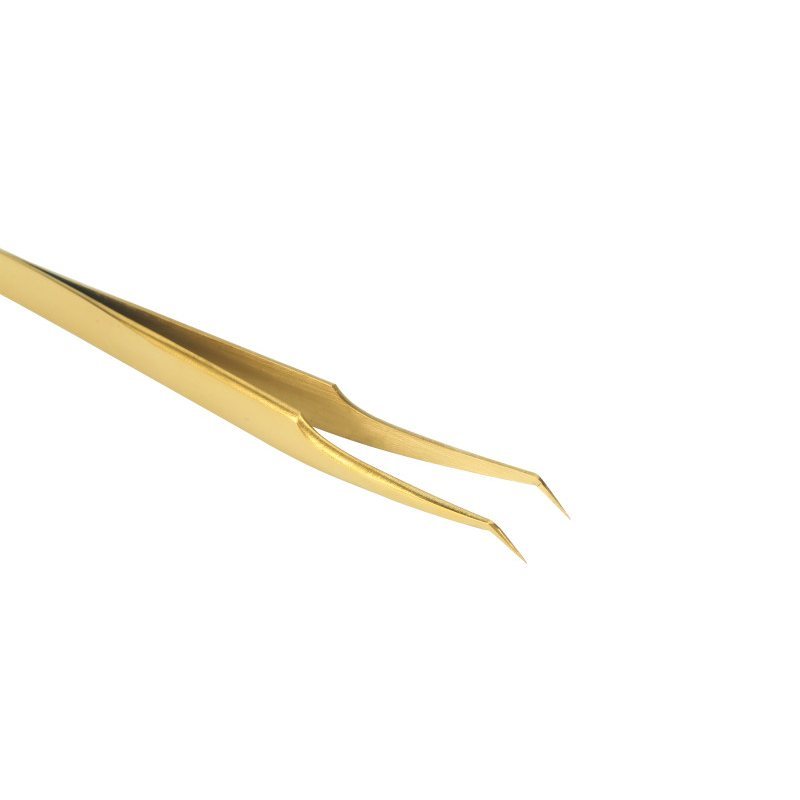
4. Curved Isolation Tweezer
Considered one of the most comfortable to use. Its shape reduces pressure on the patch and makes it easier to reach the base of the lashes.
5. Multifunctional Tweezer
A versatile tool that can serve for both isolation and classic application, and in some cases for small fans (2D–3D). Ideal as a backup tweezer in a lash artist’s kit.
Volume Tweezers – The Fan-Making Tool
For Russian Volume techniques, tweezers specifically designed for fan-building are essential. They stand out for their:
- thicker foot (base)
- stronger grip
- greater stability under pressure
It’s precisely the foot construction that determines grip quality and the ability to build a neat, even fan.
Regular Volume Tweezers
Longer, stable tweezers — often chosen by lash artists working with classic 3D–6D fans.
Fine Tipped Volume Tweezers
A slimmer tip makes it easier to build larger fans and work with shorter lengths. Often more comfortable for lash artists with smaller hands.
Working Angle and Ergonomics
Your tweezer choice should take your natural hand angle into account. Some models offer nearly a 90-degree angle, others around 45 degrees. This difference can significantly impact comfort during long lash sessions.
The best selection method is a hands-on test — hold the tweezer, check the balance, and feel how much pressure is needed to close the tips.
Can You Do Everything with One Tweezer?
Theoretically yes — many lash artists can build a fan even with an isolation tweezer. But professional work requires tools matched to the technique.
For classic sets, good isolation tweezers are enough for separating and picking up individual lashes. For volume work — dedicated volume tweezers with the right foot are necessary.
It’s also worth having a backup tweezer — dropping a tool on the floor can alter the tip geometry and make further work impossible.
Most Common Tweezer Selection Mistakes
- choosing a shape based solely on other artists’ recommendations
- not accounting for hand size
- using isolation tweezers for large fans
- not testing grip before purchasing
